Gemini Omni 1.2 Flash: Fast and cost-effective with longer clips
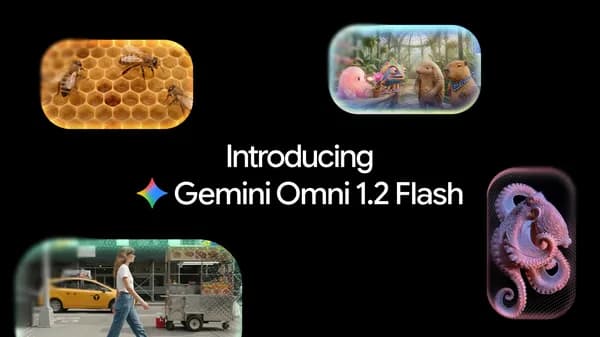
Google has released Gemini Omni 1.2 Flash, an updated version of its lightweight multimodal model that adds native video generation and editing as core capabilities. The most notable change on the output side is support for clips up to 15 seconds - a meaningful step up from shorter durations that have typically constrained what developers could produce in a single inference call.
The update also addresses consistency, one of the persistent pain points in generative video. Maintaining coherent motion, stable subjects, and visual continuity across frames has been a known challenge for diffusion-based and autoregressive video models alike. Google's claim of stronger consistency in this release suggests iterative work on the model's temporal understanding, though real-world outputs will determine how well that holds up across varied prompts and scenes.
On the editing side, native video editing support means users can modify existing clips directly through the model rather than relying on separate post-processing pipelines. This kind of integrated approach can simplify workflows for developers who need to build generation and refinement into the same product experience, without stitching together multiple models or APIs.
The 30% price reduction is perhaps as significant as the capability additions for the developer audience this model targets. Flash-tier models are positioned around speed and cost efficiency, and lowering the price point makes higher-volume video generation more practical for production applications. Combined with the longer clip length and editing support, the update positions Gemini Omni 1.2 Flash as a more complete tool for teams exploring video generation at scale without the overhead of running larger, more expensive models.