MiniMax M3 launches on NVIDIA platform with Free Endpoint
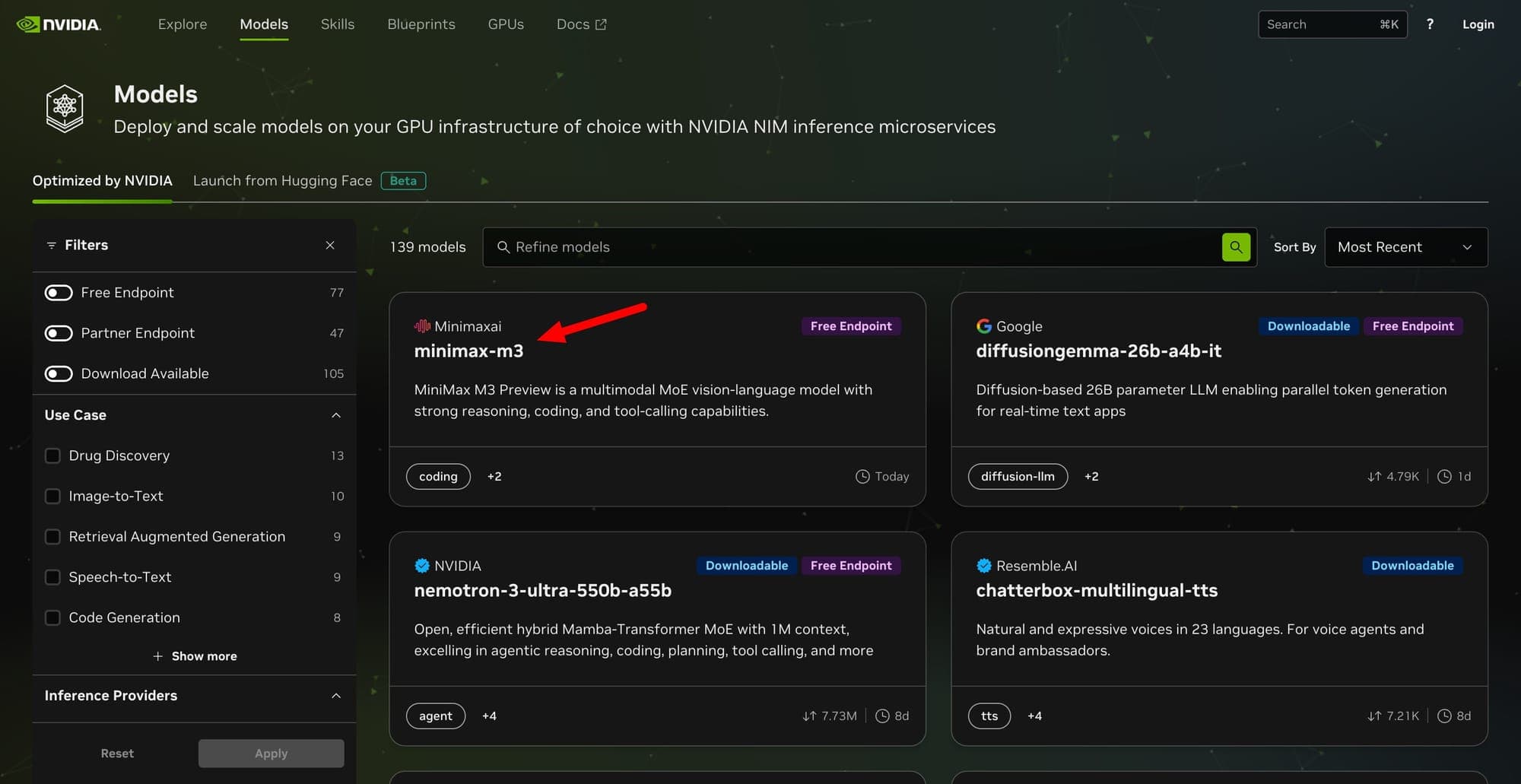
MiniMax M3 has arrived on NVIDIA's accelerated compute platform, bringing with it a free API endpoint that lowers the barrier to entry for developers and researchers wanting to experiment with the model. The availability through NVIDIA's infrastructure means users can access M3 without immediately committing to usage costs, which is a meaningful step for broader adoption.
The model is multimodal, handling text, image, and video inputs within a single architecture. This breadth of modality support puts M3 in a growing category of models designed to work across content types rather than specializing in just one - a design direction that reflects where much of the industry has been heading as practical use cases increasingly involve mixed media.
One of the more technically notable aspects of M3 is its use of sparse attention. Standard attention mechanisms scale poorly with sequence length, becoming computationally expensive as context grows. Sparse attention addresses this by selectively attending to subsets of tokens rather than every possible pair, which allows the model to handle longer inputs - documents, extended video sequences, or multi-turn interactions - without a proportional explosion in compute cost.
Running on NVIDIA accelerated compute ties the model to hardware that is already widely used in production AI workloads, which should ease integration for teams already operating within that ecosystem. MiniMax, a Shanghai-based AI company, has been building out its model portfolio steadily, and making M3 accessible through a major platform like NVIDIA's represents a clear effort to reach a wider developer audience outside of its primary markets.