gen‑ai.news
← Back
Multimodal

ByteDance Releases Lance, a 3B-Parameter Unified Model for Image and Video Generation and Editing
ByteDance Releases Lance, a 3B-Parameter Unified Model for Image and Video Generation and Editing

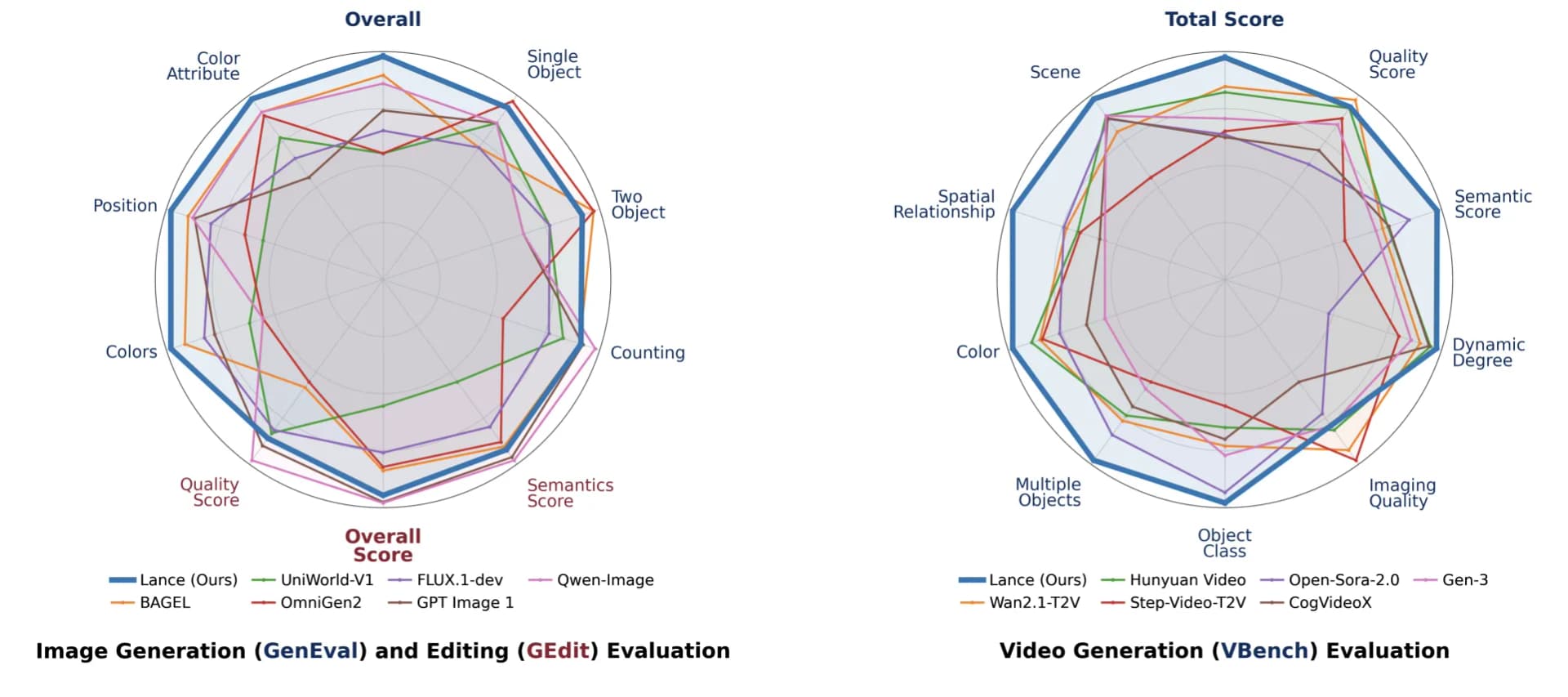
Lance is a new open-source model from ByteDance's Intelligent Creation Lab that combines image understanding, image generation, video understanding, video generation, and editing into a single architecture using only 3 billion activated parameters. The goal is to replace the common practice of stitching together task-specific models with a single system that shares representations across modalities.

The unified design has practical implications beyond parameter efficiency. When a model is trained jointly on understanding and generation tasks across both image and video, it can draw on visual comprehension when generating - for example, applying knowledge of what a scene contains when editing only part of it. Separate models for each task lack that shared context and often produce edits that are inconsistent with the rest of the frame.

At 3B activated parameters, Lance sits in a range that makes it feasible to run on research hardware or reasonably sized cloud instances, which matters for an open-source release. ByteDance has made both code and weights available, allowing external researchers and developers to fine-tune or build on the model without going through an API.

The release arrives as several labs are pursuing similar unified architectures. The value of any single unified model ultimately depends on whether the joint training actually improves task performance rather than just reducing model count, and independent benchmarking of Lance's generation quality relative to specialised models will be the real test. ByteDance has not yet published detailed benchmark comparisons against task-specific alternatives.

Enjoy this story? Get the next one in your inbox.

Twice a week: the most important stories in generative image and video AI, distilled into a 2-minute read.

Free. Unsubscribe any time. No spam, ever.

Your next read

What Is MAX Sneaks? Your First Look at Tools That Don’t Exist Yet
Multimodal

What Is MAX Sneaks? Your First Look at Tools That Don’t Exist Yet

Adobe MAX Sneaks is an annual event where Adobe researchers demo experimental technology that has not yet made it into any product. Some of these demos eventually become familiar tools in Premiere, After Effects, or Photoshop - others never ship at all. This year's Sneaks airs Wednesday, November 11, and is free to watch online.

Adobe’s AI experiments let you walk around in photos and interview your characters
Multimodal

Adobe’s AI experiments let you walk around in photos and interview your characters

Adobe's annual Max conference has brought a fresh batch of experimental features, including tools that convert flat photos into navigable 3D scenes, let creators shape AI characters through conversation, and simplify photo editing to a copy-and-paste workflow. These "Sneaks" projects offer a glimpse into where Adobe's generative AI research is heading. None are shipping products yet, but they reflect the direction of the company's broader creative toolset.

Tom Hanks Played Five Characters in This 2004 Christmas Movie
Multimodal

Tom Hanks Played Five Characters in This 2004 Christmas Movie

The Polar Express, Robert Zemeckis's 2004 performance-capture film, is back in seasonal rotation - and it remains one of the more technically unusual productions of its era. Tom Hanks played five distinct characters across 38 days of work, a casting choice that was rooted in story logic as much as technical curiosity. Here is a closer look at how that decision came together and what it meant for the actors involved.