Gemini Immersive View appears in the "Students" section
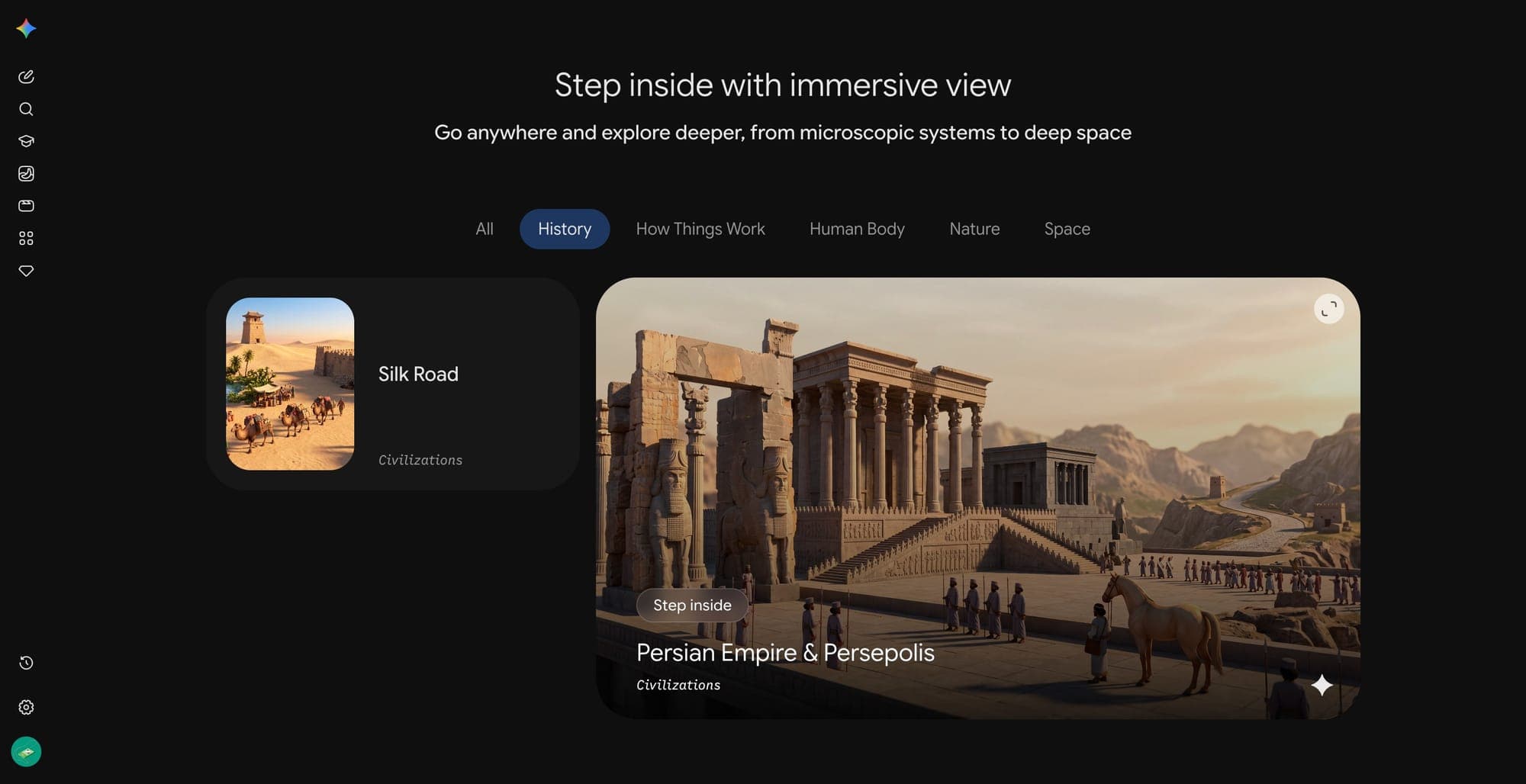
Google's Gemini app is quietly testing a feature called Immersive View, surfaced within a dedicated "Students" section of the application. Rather than presenting information as plain text, the feature organizes topics into a visual, image-based layout with nested nodes that users can explore in a non-linear way. Early screenshots suggest the experience is designed to make subject discovery feel more intuitive for learners.
The node-based structure appears to work by letting a central topic branch outward into related subtopics, each represented visually. Examples observed during testing span a wide range - from natural history subjects like dinosaurs to scientific concepts at the molecular level - suggesting the feature is aimed at broad educational use rather than any single discipline.
This kind of visual topic exploration sits at an intersection that generative AI is well positioned to serve. By pairing image generation or retrieval with structured knowledge graphs, a system can present information in ways that feel engaging without requiring a user to construct a search query. For students in particular, the ability to browse laterally across a subject - rather than drilling straight down through text - can help build context before deeper study.
Immersive View has not been officially announced by Google, and its presence in the Students section suggests it remains in an experimental or limited testing phase. It is consistent with a broader pattern of Google embedding Gemini more deeply into productivity and education contexts, where differentiated interfaces for specific user groups - students, professionals, developers - are becoming more common. Whether the feature makes it to a wider release remains to be seen.