Introducing Gemini 3.8 Live with Live Avatar
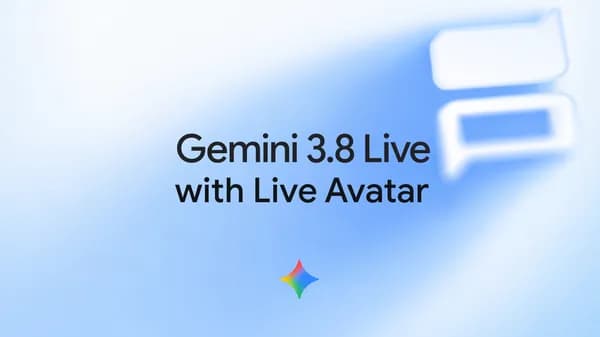
Google has announced Gemini 3.8 Live with Live Avatar, an update to its Gemini conversational AI platform that introduces a visual component to live interactions. Rather than communicating through voice alone, users now see an animated avatar that moves and responds in near real time alongside the spoken dialogue. The addition brings a more human-like quality to AI conversations without requiring any physical camera presence on the model's end.
Live Avatar builds on the existing Gemini Live framework, which was already capable of sustained back-and-forth voice conversations with low latency. The new layer generates a visual representation that is synchronized to the audio output, meaning the avatar's appearance - including mouth movement and expressive cues - tracks closely with what Gemini is saying at any given moment. This kind of tight audio-visual coupling has historically been a technical challenge, particularly in systems that need to operate with minimal delay.
The practical appeal here is partly psychological. Research into human-computer interaction has long suggested that a visible "face" during conversation can make exchanges feel more natural and easier to follow, especially for longer or more complex interactions. For Google, Live Avatar also positions Gemini as a more direct competitor to voice-and-video AI interfaces from other developers who have been experimenting with similar real-time avatar technologies.
It is worth noting that near real-time visual generation of this kind places meaningful demands on both the model and the underlying infrastructure. How the avatar is rendered - whether through a pre-built parametric model, neural synthesis, or a hybrid approach - will matter for how expressive and adaptable it can be across different conversational contexts. Google has not yet provided an extensive technical breakdown, but the feature's integration into the broader Gemini Live product suggests it is intended as a stable, user-facing capability rather than a limited experiment. Further details on availability and supported platforms are expected as the rollout continues.