gen‑ai.news
← Back
Image

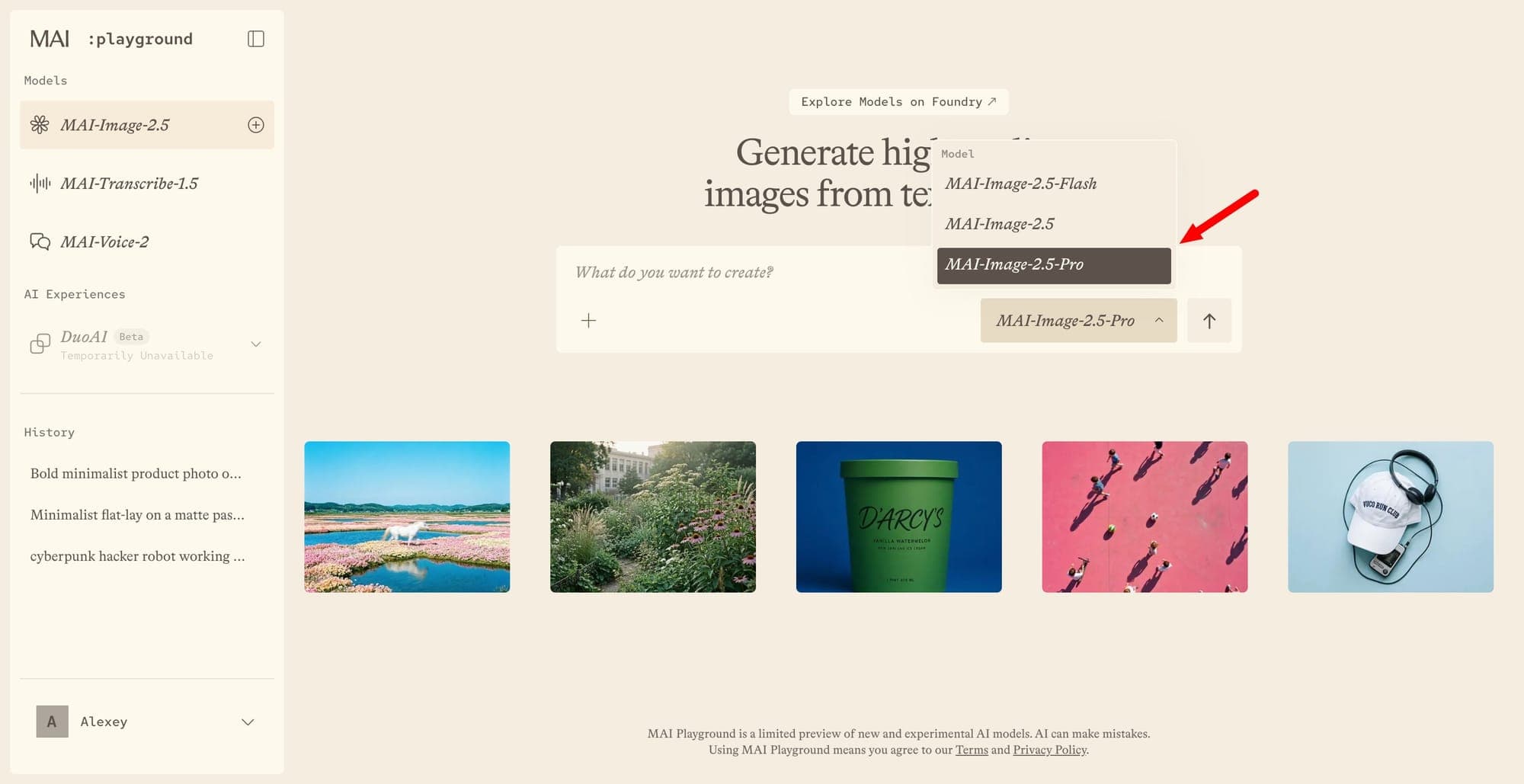
Microsoft previews MAI-Image-2.5-Pro and MAI-Voice-2-Flash
Microsoft previews MAI-Image-2.5-Pro and MAI-Voice-2-Flash

Microsoft has introduced two new models under its MAI family through Azure AI Foundry: MAI-Image-2.5-Pro and MAI-Voice-2-Flash. The former targets high-fidelity visual output, while the latter is positioned as a faster, lower-cost option for speech generation. Both are in preview, meaning developers with Foundry access can begin evaluating them before any general release.

MAI-Image-2.5-Pro sits in Microsoft's image generation lineup as a model built for quality-focused use cases - scenarios where detail and visual accuracy take priority over speed or cost. The "2.5-Pro" naming follows a convention similar to what other labs use to distinguish capable, higher-tier models from their more lightweight counterparts, suggesting this is intended as a more capable offering within the MAI image family.

MAI-Voice-2-Flash, on the other hand, carries the "Flash" label that has become shorthand across the industry for models optimized for latency and cost rather than maximum quality. For developers building applications where speech needs to be generated quickly and at scale - such as voice assistants, automated call systems, or real-time narration - a faster, cheaper speech model can meaningfully affect the practicality of deployment.

The releases fit into a broader pattern of Microsoft developing its own first-party models to complement the third-party offerings already available through Azure AI Foundry and its partnership with OpenAI. Having proprietary models gives Microsoft more control over pricing, latency, and the ability to offer differentiated options to enterprise customers. With both models currently in preview, further details on benchmarks, pricing tiers, and availability timelines are likely to follow as testing progresses.
Enjoy this story? Get the next one in your inbox.

Twice a week: the most important stories in generative image and video AI, distilled into a 2-minute read.

Free. Unsubscribe any time. No spam, ever.

Your next read

Trump Shares Doctored Photo That Appears to Replace Official With Natalie Harp
Image

Trump Shares Doctored Photo That Appears to Replace Official With Natalie Harp

President Trump shared a doctored photo on Truth Social depicting himself alongside Chinese President Xi Jinping, with experts concluding that an official in the original image appears to have been replaced with Trump aide Natalie Harp. The incident adds to a growing pattern of manipulated images circulating at the highest levels of politics. It raises fresh questions about the role of AI-assisted photo editing in shaping public perception of diplomatic events.

You Can Edit Your Photos With Lightroom and Photoshop Inside Google Gemini
Image

You Can Edit Your Photos With Lightroom and Photoshop Inside Google Gemini

Adobe is bringing Lightroom and Photoshop editing capabilities directly into Google Gemini, allowing users to work with its tools without leaving the AI platform. The move extends Adobe's broader strategy of embedding its software into third-party AI environments, following earlier integrations with ChatGPT, Claude, Slack, and Microsoft Copilot.

No image
Image

Edit updates, thumbnail previews, and more

Midjourney has rolled out a set of interface updates on its alpha site, including live style previews that show how a prompt looks across different styles before committing to one. The update also brings thumbnail previews and refinements to the Edit workflow. These changes reflect the team's ongoing work to make the image generation and editing experience more interactive and informed.