Runway News | Introducing Enhance Frame Rate
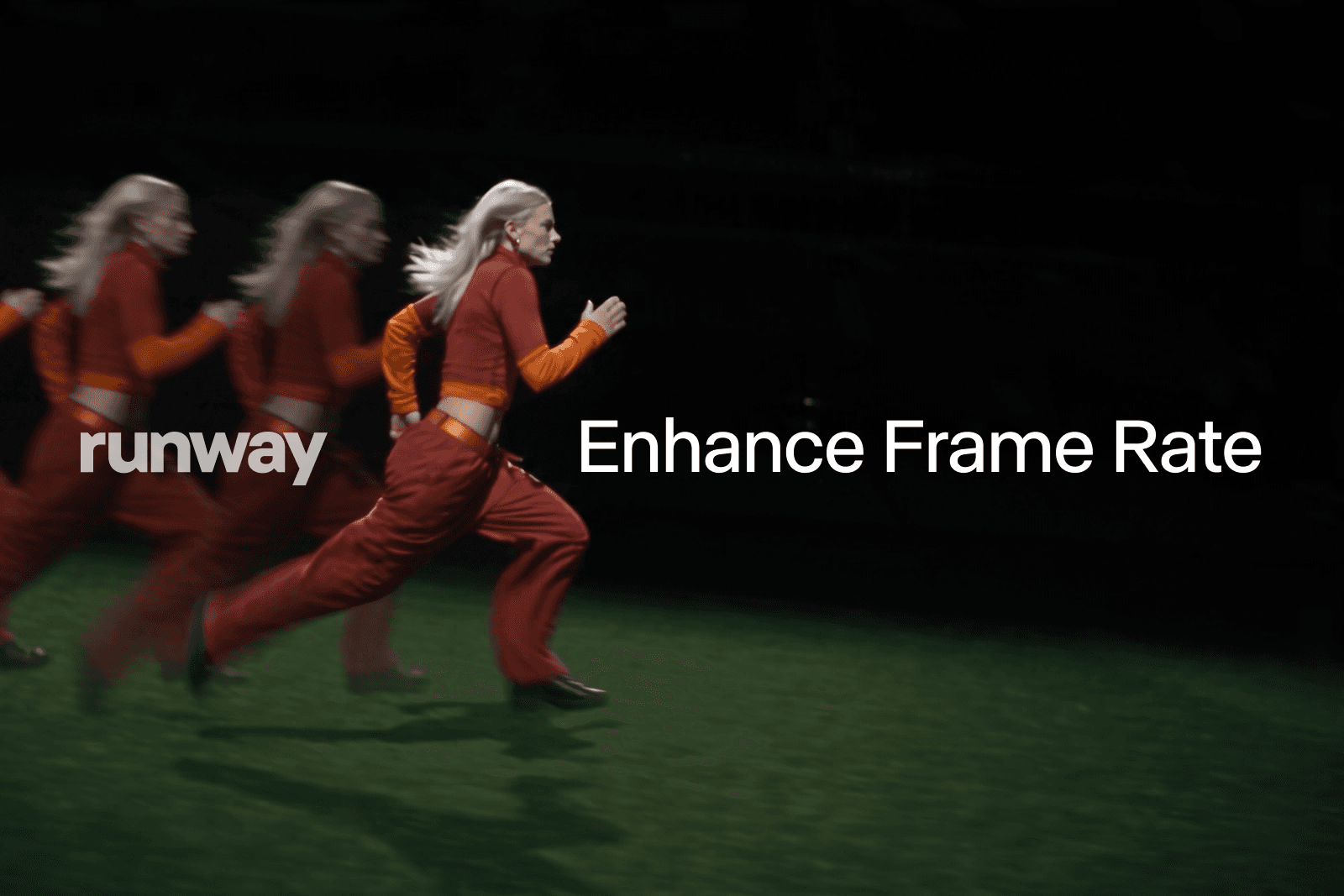
Runway has introduced Enhance Frame Rate, a new model designed to convert video content to higher, broadcast-ready frame rates. The tool works across any resolution and, according to Runway, operates up to seven times faster than other frame interpolation solutions currently available. The announcement positions it as a practical utility for both professional post-production workflows and individual creators working with AI-generated or live-action footage.
Frame rate interpolation is the process of generating new frames between existing ones to increase the overall cadence of a video - for example, taking footage shot at 24fps and producing a smooth 60fps output. Doing this well requires the model to accurately predict motion between frames, a task that becomes more demanding at higher resolutions or with complex motion. Speed has historically been a bottleneck in this area, making Runway's claim of a seven-times improvement notable if it holds across varied content types.
Runway has been steadily building out a suite of video-focused AI tools alongside its core generation models, including features for motion control, inpainting, and upscaling. Enhance Frame Rate fits into that broader pattern of offering finishing and post-processing capabilities that complement the initial generation step. For users working with AI-generated video - which often renders at lower frame rates by default - having a fast, high-quality interpolation step in the same platform reduces the need to move footage between different tools.
The practical appeal here is straightforward: smoother video looks more polished in contexts like advertising, broadcast, and social media, and achieving that without long processing queues lowers the barrier for iterative creative work. Runway has not published detailed technical specifics about the underlying model architecture, but the emphasis on speed and resolution flexibility suggests optimizations aimed squarely at production use cases rather than experimentation alone.