Microsoft launches seven MAI models at Ignite 2026
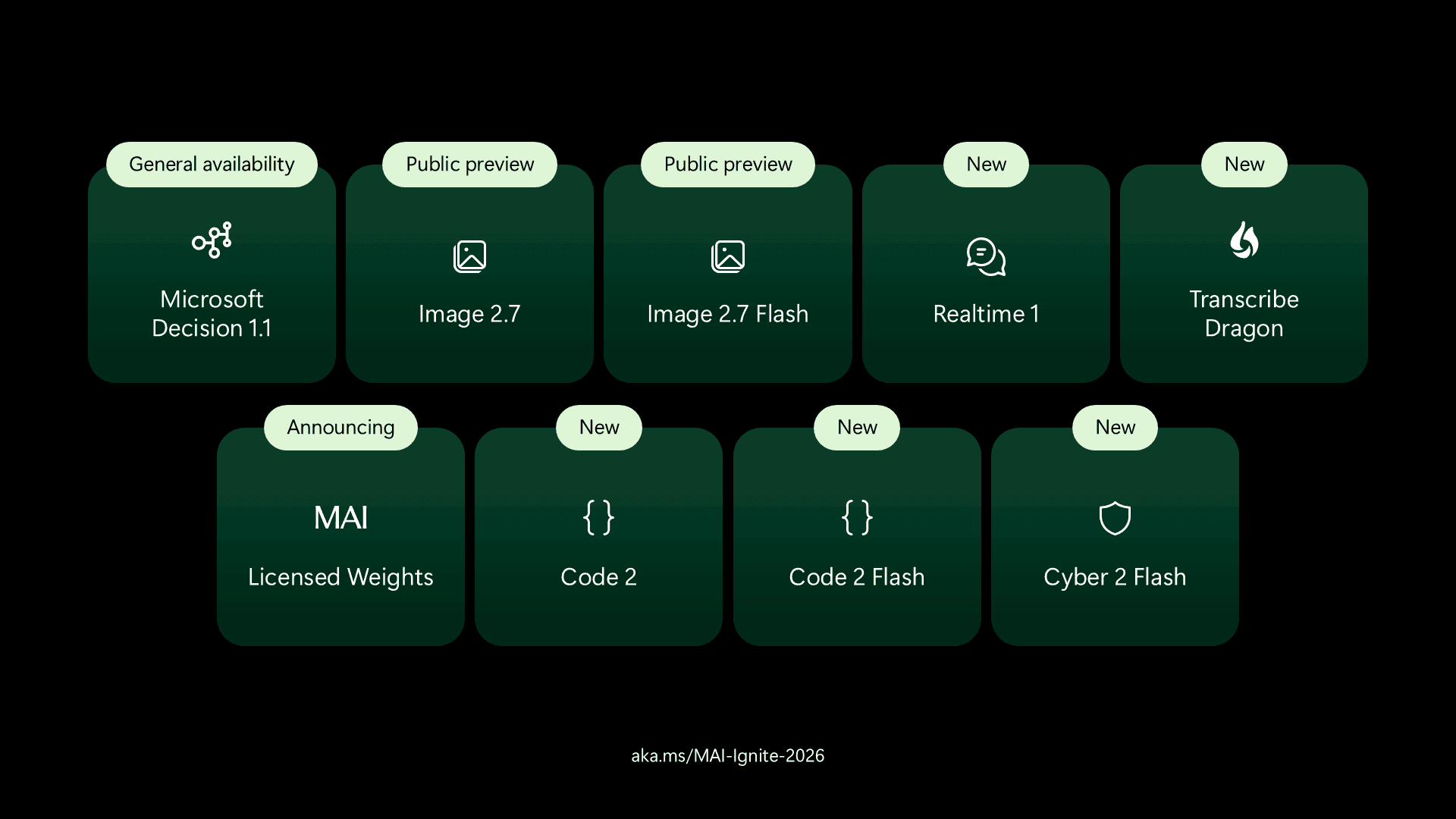
At its Ignite 2026 conference, Microsoft announced seven new models under the MAI (Microsoft AI) branding, covering a range of capabilities from code assistance to image generation. The lineup includes MAI Code 2, MAI Cyber 2 Flash, MAI Image 2.7, MAI Realtime 1, and MAI Decision 1.1, among others. The breadth of the release suggests Microsoft is investing heavily in building first-party model infrastructure rather than relying solely on third-party providers.
MAI Code 2 is positioned as a direct contributor to GitHub Copilot, Microsoft's widely used coding assistant. By developing its own code-focused model, Microsoft gains more control over the capabilities, cost, and latency of Copilot's underlying engine - an important consideration as competition in AI-assisted development continues to intensify. MAI Cyber 2 Flash appears oriented toward security workflows, potentially feeding into Microsoft's Security Copilot product, though specific performance benchmarks were not detailed at launch.
On the generative image side, MAI Image 2.7 is a notable addition. Microsoft has previously integrated third-party image models - most visibly DALL-E via its partnership with OpenAI - into products like Bing Image Creator and Designer. A proprietary image model at version 2.7 implies a sustained internal development track, and its integration path across Microsoft's consumer and enterprise tools will be worth watching. MAI Realtime 1 and MAI Decision 1.1 round out the portfolio, with the latter likely targeting agentic and automation use cases where structured decision logic is needed.
The MAI family as a whole reflects a pattern seen across the industry, where large technology companies are building in-house model stacks to reduce dependency on any single external provider and to optimize for their specific product surfaces. For Microsoft, which has made Azure AI Foundry a central hub for model access and deployment, expanding the MAI catalog gives enterprise customers more options tuned to Microsoft's own ecosystem. Further technical details, pricing, and availability timelines are expected to follow in the weeks after the conference.