gen‑ai.news
← Back
Multimodal

Start building with Nano Banana 2 Lite and Gemini Omni Flash
Start building with Nano Banana 2 Lite and Gemini Omni Flash

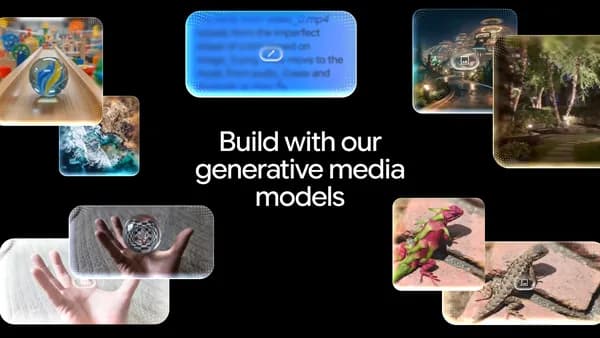
Google has announced the availability of two new generative media models: Nano Banana 2 Lite, a lightweight image generation model, and Gemini Omni Flash, designed for video generation and conversational editing. The releases appear targeted at developers and builders who need capable models at lower cost and latency than flagship offerings.

Nano Banana 2 Lite sits at the efficient end of Google's image model lineup, prioritizing speed and cost over raw output quality. This kind of tiered model strategy is common across the industry - it lets developers prototype quickly, run high-volume workloads affordably, and integrate image generation into products where strict budget constraints apply. The "Lite" designation signals it is a smaller, distilled variant of a larger model in the Nano Banana 2 family.

Gemini Omni Flash extends the Gemini model family into video, offering what Google describes as high-quality video generation alongside conversational editing - a workflow where users can iteratively refine video output through natural language instructions. Conversational editing has been an active area of development across the industry, as it lowers the barrier for non-technical users to make precise adjustments without learning dedicated editing tools.

Together, these two models reflect a broader push by Google to make generative media capabilities accessible at different price and performance points. With both models now open for developer access, the near-term focus will likely be on how well Nano Banana 2 Lite holds up in real-world image quality benchmarks relative to competitors, and whether Gemini Omni Flash's conversational video editing delivers consistent, controllable results in practice.

Enjoy this story? Get the next one in your inbox.

Twice a week: the most important stories in generative image and video AI, distilled into a 2-minute read.

Free. Unsubscribe any time. No spam, ever.

Your next read

No image
Multimodal

Google’s new SynthID website can identify AI-generated media

Google has launched a public-facing website for SynthID, its AI watermarking technology, allowing anyone to upload and check whether an image, video, or audio clip was generated by AI. The tool extends SynthID beyond its previous developer and enterprise integrations, putting detection capabilities directly in the hands of everyday users. This marks a notable step toward accessible, practical tools for identifying synthetic media in the wild.

Reka AI's omni-model Rho-1 handles text, images, video, and robot control in a single model
Multimodal

Reka AI's omni-model Rho-1 handles text, images, video, and robot control in a single model

Reka AI has released Rho-1, a 19-billion-parameter model that handles text, images, video, and robot control actions within a single neural network. Rather than routing different tasks to specialized subsystems, it processes all modalities as tokens in one shared context window. The model was trained on 320 H100 GPUs over roughly three months, using considerably less compute than many leading models today.

Uniting LED Volumes and Live Visual Chaos: Cinematographer Bradford Lipson on 'Rolling Loud'
Multimodal

Uniting LED Volumes and Live Visual Chaos: Cinematographer Bradford Lipson on 'Rolling Loud'

Cinematographer Bradford Lipson explains how he and director Jeremy Garelick used LED volume technology to blend real footage from the Rolling Loud music festival with controlled stage work, creating the illusion that actors were surrounded by tens of thousands of live concertgoers. The production shot on location at the festival for just three days before rebuilding that world on the Lux Stage at Trilith Studios. Lipson walks through the technical and artistic decisions behind matching concert